
From Pre-Aksumite to Aksumite: Break or Continuity?
The transition from the early first-millennium BCE political landscape toward the Aksumite period was once easier to describe as a sharp break. Archaeological evidence now makes that picture more complicated.
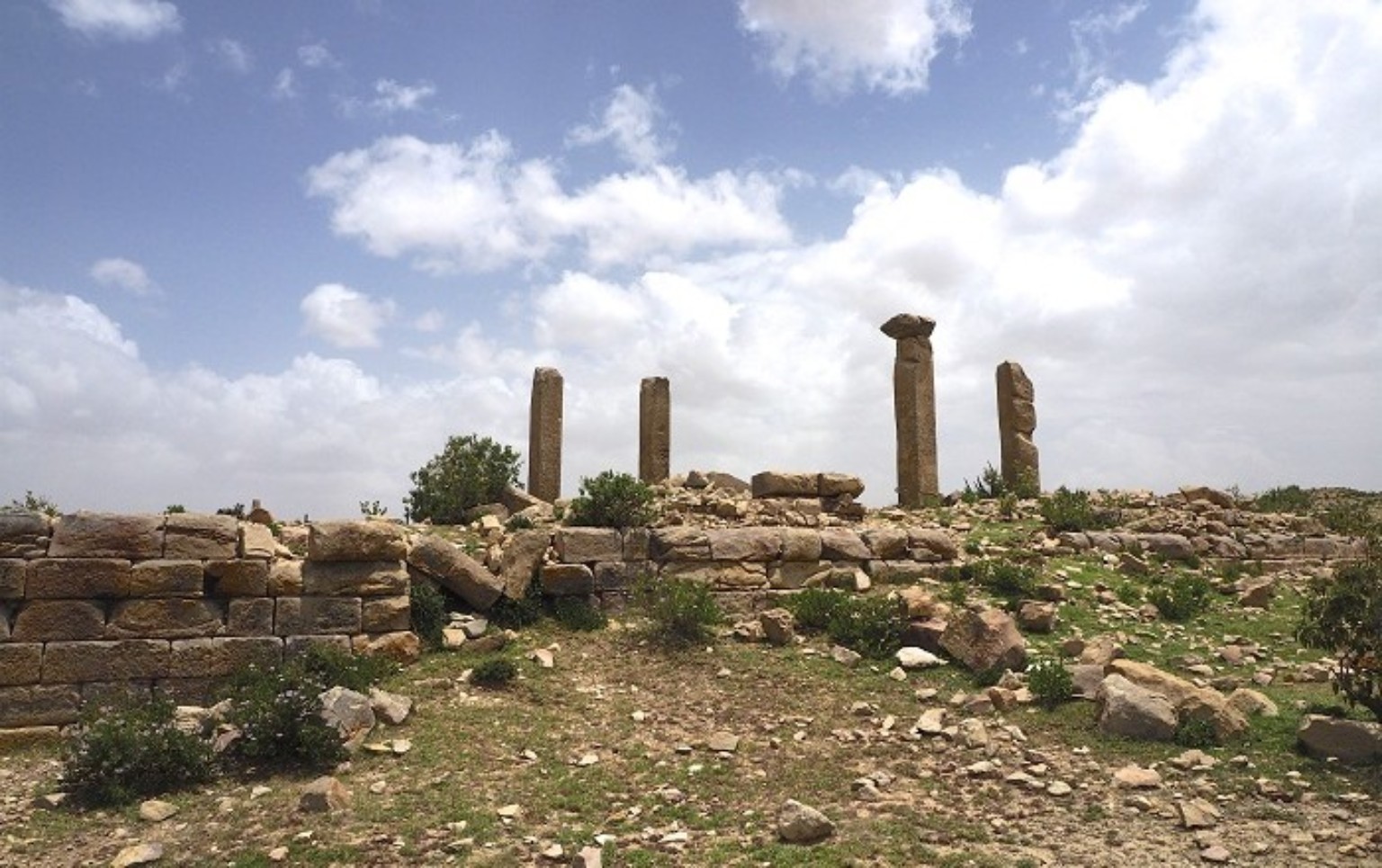
Contextual project image. It illustrates the highland setting and is not presented as a photograph of Beta Samati or as direct evidence for a particular archaeological phase.
Beta Samati changes the discussion
Excavations at Beta Samati documented occupation beginning in the Pre-Aksumite period and continuing through the Aksumite era.
The excavators argue that this evidence challenges older models in which the Yeha region was largely abandoned after the Pre-Aksumite period.
The importance of this evidence is not that every institution survived unchanged.
It demonstrates that communities, settlement, and regional activity could persist across periods once treated as sharply separated.
Continuity does not mean sameness
Aksum developed political, economic, and cultural forms that differed in important ways from earlier first-millennium BCE societies.
Kingship, monumental display, long-distance exchange, coinage, written royal ideology, and eventually Christian institutions became important features of the Aksumite world.
Settlement continuity therefore should not be confused with institutional identity.
does not necessarily mean
same political system
same religious institutions
same language use
same social identity
Ask more precise questions
Instead of asking whether one civilization disappeared and another suddenly replaced it, archaeology allows narrower questions that can be tested independently.
These questions may produce different answers. Continuity in settlement does not automatically demonstrate continuity in political administration.
The problem with rigid historical periods
Labels such as “Pre-Aksumite” and “Aksumite” are useful tools for organizing chronology.
Archaeological reality does not necessarily change at the exact point where a modern period label changes.
Material traditions can overlap. Settlements can continue while political centers shift. Older architectural or religious practices can persist beside newer institutions.
Yeha within the longer sequence
Yeha remains important because it preserves evidence from an early monumental and literate landscape with strong Sabaean connections.
Nearby evidence from Beta Samati extends regional occupation across a much longer chronological span.
Together, these sites contribute to a picture in which the northern Horn underwent substantial transformation while also preserving forms of local continuity.
Continuity can operate at different levels
Communities
People may remain in a region across major political and cultural transformations.
Places
Settlements, roads, agricultural zones, monuments, and ritual places can persist, be modified, or be reused.
Systems
Political structures, religious institutions, economic networks, and writing traditions can change even when settlement continues.
Change can occur at different speeds
Political authority may reorganize quickly while pottery traditions change more slowly.
Religious institutions may transform while some architectural techniques continue.
Long-distance exchange can expand or contract while local settlement patterns remain comparatively stable.
different parts of a society can change
at different times
and at different speeds
What can be said securely
Archaeology supports long-term occupation in parts of the northern Horn across the Pre-Aksumite and Aksumite periods.
Archaeology also documents important changes in political scale, exchange networks, monumental traditions, written expression, and religious institutions.
The surviving evidence therefore does not require a simple choice between total continuity and total replacement.
What remains interpretive
Archaeology does not automatically reveal how ancient populations defined their own collective identities.
Nor does settlement continuity by itself prove direct institutional descent between particular political systems.
Historical models connecting Pre-Aksumite and Aksumite societies must therefore specify exactly what is proposed to have continued.
Testing continuity
A stronger continuity argument requires more than resemblance between an earlier and a later form.
+
later evidence
+
chronological bridge
+
structural correspondence
+
plausible mechanism of transmission
= stronger continuity argument
The more independent evidence that connects the two periods, the stronger the historical case becomes.
Similarity is not sufficient
Two traditions can resemble one another because of direct continuity, borrowing, revival, shared environmental constraints, convergent development, or coincidence.
Historical analysis has to distinguish among those possibilities.
Why this matters for THE SABAEAN UNIVERSE
The project should not begin with the assumption that every early northern-Horn tradition either vanished completely or continued unchanged.
Instead, each proposed continuity should identify the exact category being compared.
architecture with architecture
inscriptions with inscriptions
political institutions with political evidence
religious practice with religious evidence
astronomy with independently documented astronomical practice
Continuity and HCM-364
The same standard applies to HCM-364.
If the reconstructed system proposes that an astronomical, calendrical, linguistic, symbolic, or institutional structure persisted across long periods, that continuity must be tested rather than assumed.
HCM-364 itself cannot serve as proof that a proposed continuity existed.
Evidence before synthesis
Evidence: dated occupation levels, architecture, inscriptions, ceramics, objects, settlement patterns, burials, coins, imported goods, and other documented remains.
Interpretation: historical explanations of continuity, transformation, exchange, chronology, political development, and institutional change.
Reconstruction: wider claims about uninterrupted political identity, population history, migration, cultural descent, religious continuity, or HCM-364 transmission not directly established by the surviving evidence.
The strongest current conclusion
The archaeological record supports both continuity and change between Pre-Aksumite and Aksumite periods.
Settlement continuity in some places is directly documented.
Major transformations in political organization, economy, monumental culture, writing, and religion are also documented.
The most defensible historical approach is therefore to test continuity category by category rather than treating either complete rupture or complete sameness as the starting assumption.