
Reading the Stones: An Evidence-First Epigraphy Method
The archive begins with the photographed object, not with a reconstructed sentence. That rule prevents modern restoration, decorative script, and historical interpretation from becoming confused with ancient evidence.
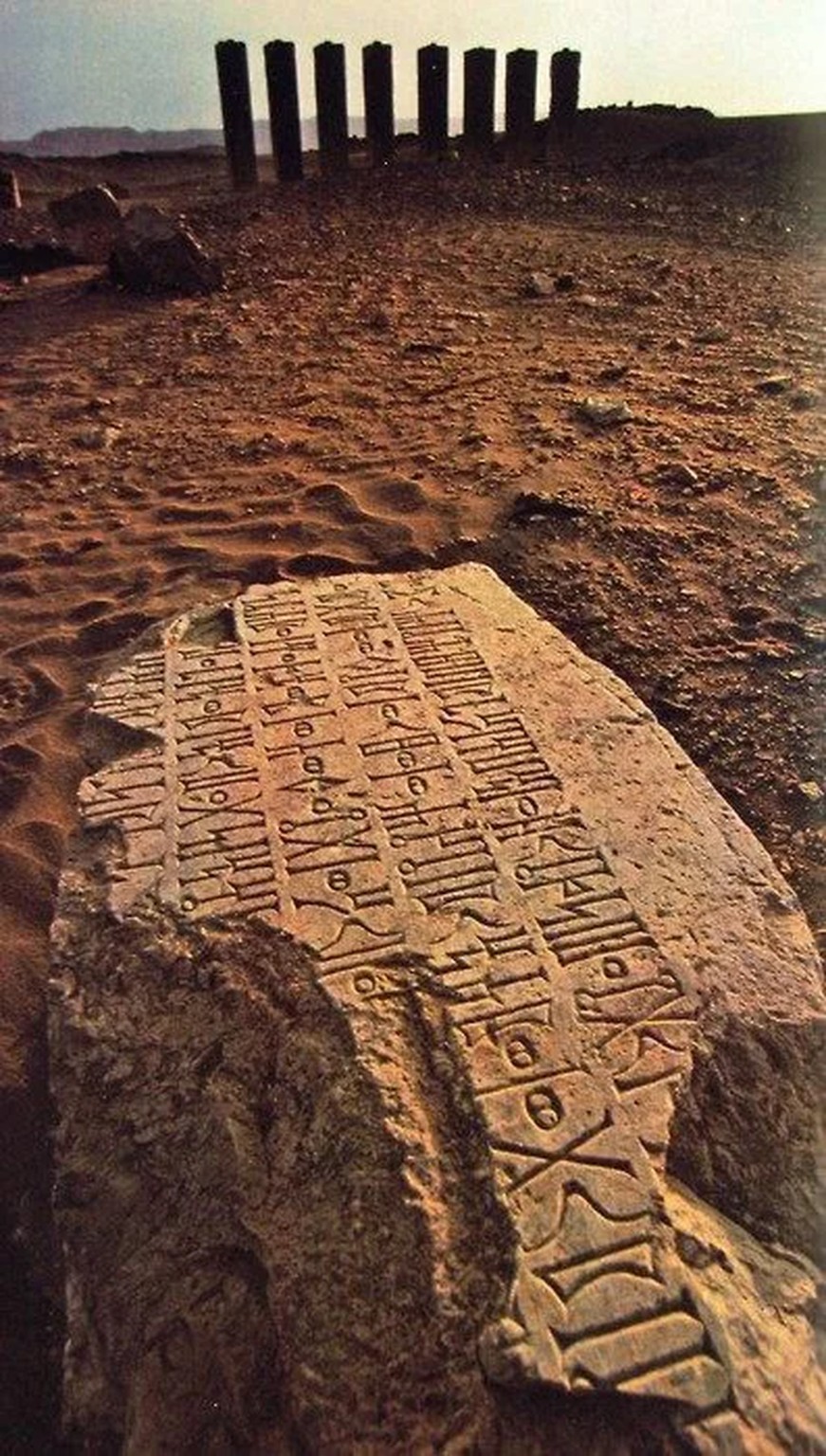
Project archive image. The photograph is used as an example of the epigraphic workflow; its presence on this page does not assign the object to a specific inscription corpus unless provenance establishes that identity.
Step 1: Preserve the source image
Keep the highest-quality original photograph available in the archive. Cropped, resized, sharpened, exposure-corrected, or contrast-enhanced versions may be useful for publication, but the unaltered archival source should remain available for comparison.
This preserves a visible chain between the physical object and every later reading, restoration, transliteration, translation, or historical claim.
Step 2: Record what is actually visible
The first textual layer should be a diplomatic or source-oriented transcription: a record of what can actually be read from the surviving object.
Clearly visible signs, damaged signs, uncertain signs, missing areas, and editorial restorations should not be silently collapsed into one smooth sentence.
A character supplied by a modern editor is not the same category of evidence as a character clearly preserved on the stone.
Step 3: Record provenance
Each inscription record should preserve as much contextual information as can be established.
Provenance matters because identical words can carry very different historical implications when found on a temple dedication, altar, funerary monument, royal inscription, reused block, coin, or object removed from its original setting.
Step 4: Mark restoration explicitly
Ancient surfaces are often damaged. Missing portions can sometimes be restored from surviving traces, grammar, formulaic parallels, related inscriptions, or the physical dimensions of the lost section.
A proposed restoration can be useful. The problem begins when a restoration is displayed as though those characters physically survive on the object.
Step 5: Label uncertainty
If a sign, word division, personal name, title, grammatical form, date, or restoration is uncertain, the uncertainty should be preserved rather than hidden behind a single confident reading.
Where credible competing readings exist, they should be recorded together with the reasons for preferring one interpretation over another.
Step 6: Distinguish transcription, transliteration, and translation
These stages are related, but they are not the same operation.
records the surviving written signs as faithfully as possible.
Transliteration
represents those signs in a declared scholarly notation.
Normalization
may regularize a form for linguistic comparison, but should remain separate from the original reading.
Translation
expresses the interpreted meaning in another language.
Separating these layers makes disagreements easier to locate. Two scholars may agree on the visible signs but disagree about word division, morphology, grammatical analysis, normalization, or translation.
Step 7: Declare the transliteration standard
A transliteration system should be stated rather than assumed. Once a scholarly standard is selected for a publication or corpus, the same conventions should be applied consistently across names, consonants, diacritics, damaged forms, and restored readings.
If a source publication uses a different system, its original reading can be preserved while a normalized project form is supplied separately.
Step 8: Translation is interpretation
Translation involves decisions about vocabulary, syntax, titles, divine names, damaged passages, and historical context. It should therefore not be treated as though it were a photograph of the ancient sentence.
Where more than one translation is plausible, the uncertainty should remain visible.
Step 9: Separate attestation from historical interpretation
An inscription may directly attest a personal name, ruler, title, divine name, place, dedication, verb, genealogy, building activity, or political formula.
What that statement means for the wider history belongs to another analytical layer.
Step 10: Treat royal inscriptions critically
Royal inscriptions are primary evidence, but a ruler's claim should not be confused with independent confirmation of the event being described.
A victory inscription securely establishes that the ruler or royal administration publicly claimed victory. Whether every detail occurred exactly as described requires comparison with archaeology, chronology, other inscriptions, external texts, and material evidence.
+
archaeological evidence
+
chronology
+
independent textual evidence
=
stronger historical reconstruction
Visual rule across the project
authentic supplied inscription image
↓
verified published inscription image
↓
no inscription image
Generated imitation script or decorative pseudo-Musnad is not used as a substitute for ancient epigraphic evidence.
Why this method matters
Epigraphy is strongest when a reader can move backward through every stage of an argument.
↓
translation
↓
transliteration
↓
restoration
↓
diplomatic transcription
↓
source photograph
↓
archaeological object and provenance
That chain makes the evidence inspectable. It also makes errors easier to detect, disagreements easier to locate, and future corrections easier to document.
Epigraphy and HCM-364
HCM-364 may be compared with inscriptional evidence only after the source text has been established independently.
A predicted HCM term, number, deity, Gate, House, or element must never be inserted into a damaged ancient passage merely because the reconstruction expects it to be present.