
DʿMT: What the Evidence Actually Supports
DʿMT belongs to one of the earliest complex political landscapes presently documented in the northern Horn. The surviving record is important but incomplete, making the distinction between direct evidence, historical interpretation, and reconstruction essential.
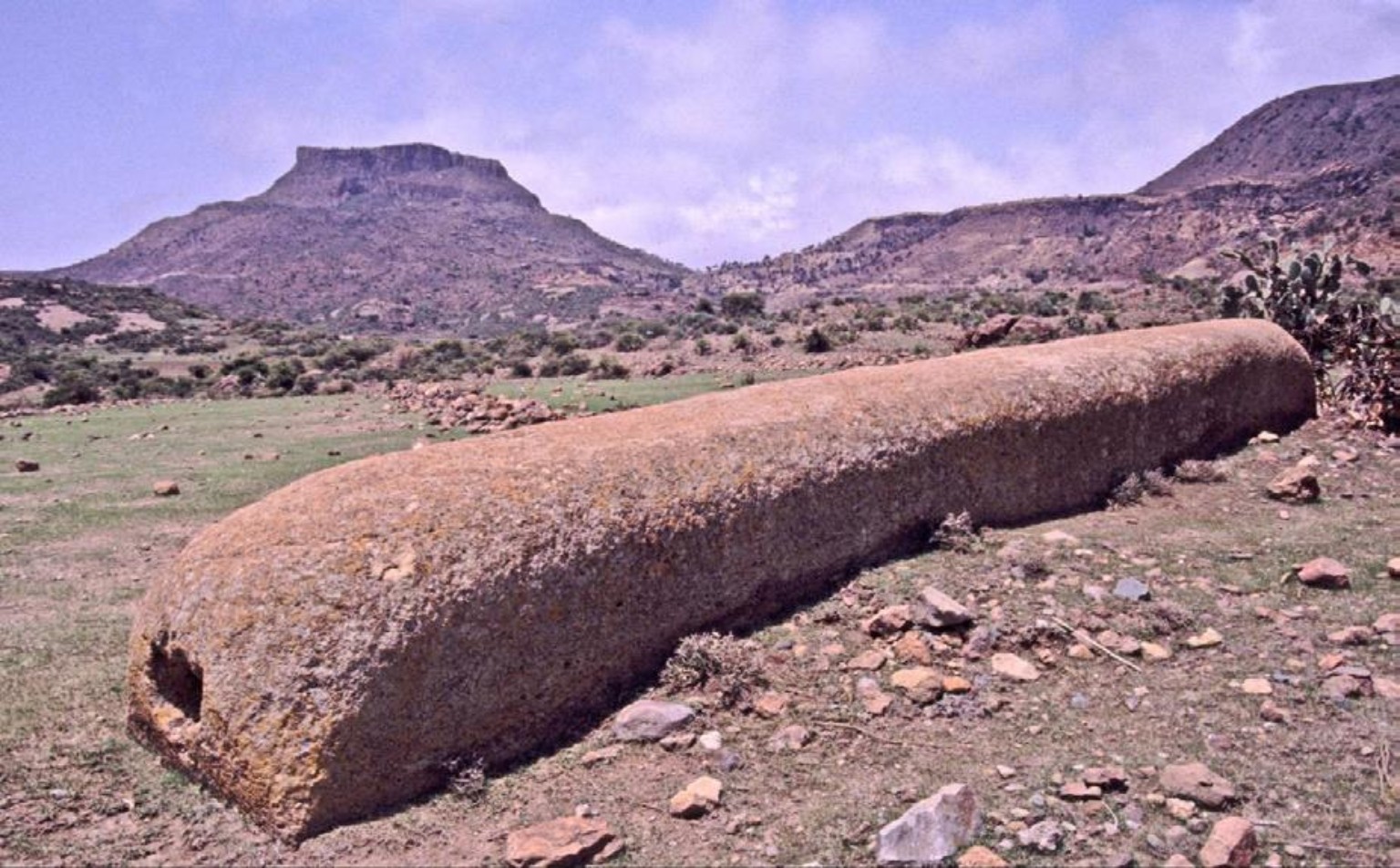
Contextual project archive image. It is not presented as a photograph of a specifically identified DʿMT monument unless independent provenance establishes that identification.
The archaeological starting point
Archaeological research around Yeha places the emergence of complex Pre-Aksumite communities in the early first millennium BCE.
Excavations and survey in the Yeha region have identified monumental architecture, settlements, inscriptions, and long-term occupation.
Research at Beta Samati also contributes evidence for the long historical development of settlement and political life in the region.
Why Yeha is central
Yeha matters because several forms of evidence converge there. Monumental architecture survives. Writing appears. Religious and political activity can be investigated through archaeology and inscriptions.
The Great Temple, generally dated to the seventh century BCE, is one of the most significant surviving structures associated with this period.
Yeha therefore provides a major anchor for reconstructing the wider political and cultural landscape in which DʿMT appears.
Sabaean connections
Archaeological and epigraphic research demonstrates substantial connections between communities of the northern Horn and ancient Saba across the Red Sea.
Relevant evidence includes architecture, inscriptions, language, religious terminology, and material parallels.
Connection does not identify the mechanism
Evidence for contact does not automatically tell us exactly how that contact operated.
Historical possibilities can include trade, movement of craftspeople, migration, elite networks, religious institutions, political relationships, intermarriage, local adoption, or combinations of several processes.
≠
proof of one specific migration or political model
What “DʿMT” tells us
The name DʿMT survives in the ancient epigraphic record.
That makes DʿMT itself part of the directly attested historical record.
What the surviving sources do not provide is a complete constitutional description of the polity or a modern-style map of its territory.
Avoid hard borders where the evidence is incomplete
Modern maps often require clean lines. Ancient archaeological evidence rarely provides them so neatly.
A map showing one fixed boundary for DʿMT can therefore communicate more certainty than the surviving record allows.
Political control may also have changed over time, making one static border inappropriate for every period.
Political organization
Monumental construction, royal terminology, sanctuaries, inscriptions, and settlement patterns provide evidence for organized institutions.
They do not automatically reveal every level of administration or define whether political power operated through a single centralized state, multiple centers, regional rulers, alliances, tributary relationships, or changing combinations of these structures.
Political reconstruction must therefore remain proportional to the surviving evidence.
African development and Red Sea exchange
The archaeological picture is better described as interactive than as a choice between purely local development and purely external origin.
Communities in the northern Horn participated in regional traditions while also maintaining connections across the Red Sea.
These processes could operate simultaneously.
+
regional development
+
Red Sea exchange
+
cultural interaction
= a more testable historical model
Continuity toward Aksum
Research at sites including Beta Samati has contributed to a more nuanced understanding of the relationship between Pre-Aksumite and Aksumite periods.
Evidence for settlement continuity makes a simple model of total cultural disappearance followed by an entirely unrelated civilization difficult to sustain.
Continuity, however, does not mean that every political institution, language, religious practice, economic system, or social identity remained unchanged.
What can be said securely
Several broad conclusions have relatively strong support.
Yeha was an important monumental and religious center
writing and monumental construction were established
substantial Sabaean connections existed across the Red Sea
local northern-Horn archaeological traditions remained part of the picture
later Aksumite development emerged from a landscape with significant earlier occupation and institutions
What remains less secure
The exact territorial boundaries of DʿMT remain uncertain.
The precise political hierarchy and relationship among regional centers remain subjects of historical reconstruction.
The scale and character of population movement across the Red Sea cannot be derived solely from architectural or linguistic similarity.
The relationship between every Pre-Aksumite institution and later Aksumite institutions must be demonstrated case by case.
Evidence: inscriptions, archaeology, architecture, material culture, settlement history, securely dated contexts.
Interpretation: political relationships, cultural interaction, institutional function, chronology, continuity, and exchange.
Reconstruction: complete territorial maps, population narratives, state structures, and wider historical syntheses not directly stated by surviving ancient evidence.
How this series proceeds
The remaining articles move from this general political problem to individual bodies of evidence: Yeha and monumental architecture, Almaqah, the epigraphic record, and continuity into the Aksumite period.
Throughout the series, the same standard applies: direct evidence first, comparison second, reconstruction third.