
Aksumite Coinage: Kings, Symbols, and Long-Distance Exchange
Aksumite coinage provides a material record of rulers, royal portraiture, inscriptions, metals, changing symbols, monetary practice, chronology, and participation in wider commercial networks.
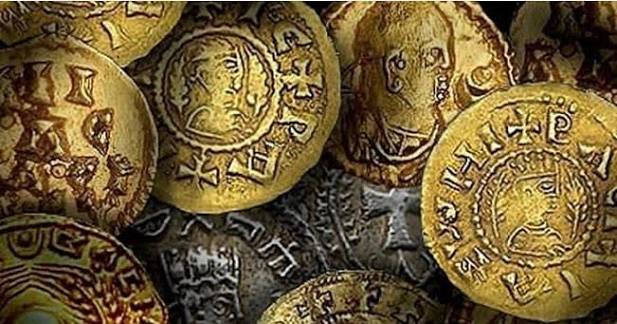
Project archive coin montage. Individual coin attributions, dates, metals, legends, and ruler identifications should be checked against published museum or numismatic catalogues when used as specific evidence.
An important coin tradition
Aksum developed its own coinage tradition during Late Antiquity. Surviving issues include gold, silver, and copper-based coins associated with a sequence of Aksumite rulers.
Coins attributed to rulers including Endubis, Ousanas, Ezana, Kaleb, and others preserve names, portraits, titles, inscriptions, and symbols that can be compared with monumental texts and archaeological evidence.
Because coins were produced in multiples and circulated, they provide a different form of historical evidence from unique monuments such as royal inscriptions or monumental stelae.
Read the legend, identify the visible symbols, establish the metal, weight, diameter, die relationship, provenance, and catalogue attribution where possible before moving to broader historical interpretation.
Royal names and portraiture
Coinage allowed rulers to circulate political imagery in a portable form. Portraits, crowns, royal names, inscriptions, and symbols could communicate authority beyond the immediate setting of a palace or stone monument.
The historical interpretation of circulation still requires context. A surviving coin does not automatically reveal where it was originally used, how long it remained in circulation, or who handled it.
Symbols change over time
Aksumite coinage preserves changes in royal symbolism across different rulers and chronological phases.
Some earlier issues display disc-and-crescent motifs. Later issues include Christian crosses. These are directly visible changes in the symbols used on royal coinage.
The symbols should be described before their complete meaning is assigned. A disc, crescent, cross, crown, spear, staff, or other motif is directly observable evidence. Its theological, political, or cultural meaning requires interpretation.
≠
complete theology
visible symbol
+
inscription
+
chronology
+
archaeological context
+
comparative evidence
=
stronger interpretation
Ezana and changing royal representation
Coinage associated with the period of King Ezana is particularly important because fourth-century evidence also documents major changes in Aksumite royal religious representation.
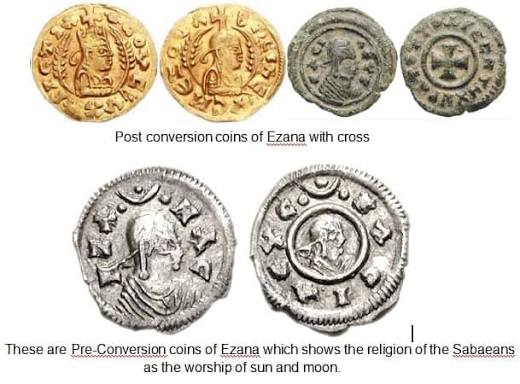
Project archive image associated with Ezana. Specific ruler attribution, issue sequence, metal, date, and catalogue identification should be confirmed before any individual coin is used as chronological proof.
Comparing coin types with inscriptions can help researchers investigate when particular symbols entered royal representation and whether changes occurred at the same time across different media.
Coinage and religious change
Christian symbols on later Aksumite coinage provide material evidence that Christianity became part of royal public representation.
A coin alone cannot establish the beliefs of the entire population. Royal coinage primarily tells us about imagery and language authorized for an official monetary medium.
Inscriptions, architecture, archaeology, chronology, and other independent evidence are needed before broader conclusions are made about religious transformation across society.
Gold, silver, and copper
Different metals and denominations may have served different economic, political, and ceremonial functions.
Gold coinage is especially important in discussions of prestige and long-distance exchange, while silver and copper-based issues provide other evidence for monetary activity and circulation.
Metallurgical analysis, weights, die studies, hoards, production patterns, and securely documented archaeological findspots can help reconstruct how Aksumite coinage developed through time.
Coins and long-distance exchange
Aksum participated in Red Sea and wider maritime exchange systems. Coinage forms one part of the evidence for that participation.
Coins discovered away from their production center can contribute to the study of movement and contact, but their presence requires interpretation. Coins may travel through commerce, military activity, diplomatic exchange, gifts, reuse, later collecting, or other processes.
≠
automatic proof of Aksumite territorial control
find context
+
chronology
+
distribution pattern
+
independent evidence
=
stronger historical conclusion
Coins are not photographs of society
Royal coins reveal how authority chose to represent itself. They do not directly measure what every subject believed, how wealth was distributed, or how frequently formal coinage was used in ordinary transactions.
Numismatic evidence becomes much stronger when combined with archaeological context, inscriptions, metallurgy, settlement evidence, trade archaeology, and chronology.
Why coinage matters for chronology
Coin sequences can contribute to establishing the order of rulers and the development of royal imagery. Changes in legends, portraits, symbols, weights, and metals can help define relative phases when supported by numismatic study.
This makes coinage one of the most valuable independent evidence streams for reconstructing Aksumite political and religious history.
Evidence: surviving coins, legends, portraits, symbols, metals, weights, dies, and archaeological contexts.
Interpretation: arguments about monetary use, royal messaging, religious change, economic organization, chronology, and exchange.
Reconstruction: circulation maps, detailed monetary systems, reign sequences, and economic models extending beyond what any single coin directly demonstrates.
Project image rule
Coin montages and user-supplied images can be useful for visual comparison, but individual objects should not receive precise ruler, date, mint, metal, or religious attribution unless the identification can be checked against a reliable catalogue or publication.